Setup guide
The hour a garden pool runs
Four inches of water, a hose and an afternoon. What has to be true before the pump goes on.
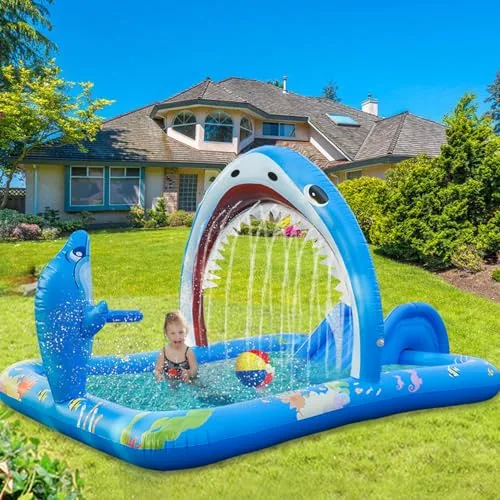
A garden pool is the least complicated thing we make and the only one with a guide that opens like this.
Shallow water is not safe water. The Centers for Disease Control and Prevention publishes the figure that decides how this piece gets used in our own gardens:
More children ages 1–4 die from drowning than any other cause of death.
Centers for Disease Control and Prevention, Drowning Facts
Not the leading cause among accidents. The leading cause of death, of any kind, in that age band. And the same page continues into the ages that use a pool like ours the most:
For children ages 5–14, drowning is the second leading cause of unintentional injury death after motor vehicle crashes.
Centers for Disease Control and Prevention, Drowning Facts
Nothing about the product changes those numbers. What changes them is an adult with nothing else to do.
One adult, one job
The Consumer Product Safety Commission gives that adult a name and a job description, and the second sentence is the part that gets ignored:
Always watch children when they’re in or near water, and never leave them unattended. Designate an official Water Watcher, an adult tasked with supervising children in the water.
U.S. Consumer Product Safety Commission, Pool Safety
Tasked with supervising, and nothing else. Not supervising and also turning sausages, and not supervising and also answering a message.
On a garden afternoon with four adults present this is harder than it sounds, because four adults watching is usually nobody watching. Say the name out loud, hand the job over out loud when it changes, and it works.
Empty the pool when the afternoon ends. A filled pool left overnight is an open water hazard in a garden where a child can wander at seven the next morning.
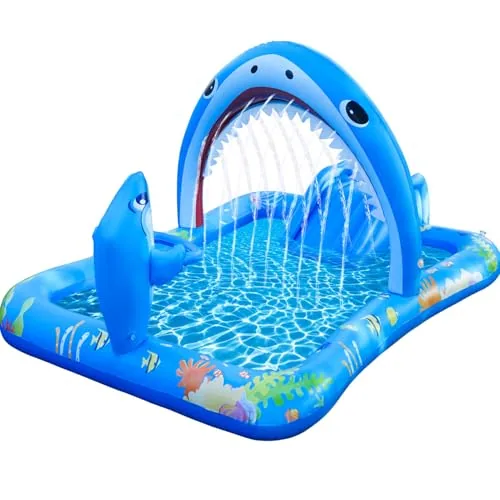
94 x 75 x 48 in, sprinkler arch, slide · $19.99
See the pieceGround, and why it decides everything after it
Level grass. That is the entire requirement, and it is the step people skip because the box is open and the children are already in swimsuits.
A slope of even a few degrees sends the water to one end, which does two things: it makes the deep end deeper than the picture on the box, and it lifts the shallow end into a lip that a running child catches.
- Walk the area barefoot first. Anything that hurts a bare foot will find quarter millimetre PVC.
- Clear stones, twigs and the hard nub left by a mown thistle. Those are the punctures, not the toys.
- Keep it off patio slabs and decking. A hard base under a wet pool is a different kind of fall.
- Face the slide away from the fence, and leave a stride of clear grass at the bottom of it.
The pump is not in the box, and that is the honest catch
You need an electric pump and one does not come with the pool. We would rather you read that here on a Wednesday than discover it at noon on a Saturday with a hose already out.
Any low pressure electric inflator does it. The valves are double lock, so once each chamber is full you fold the inner stopper in and the air stays where you put it.
Inflate before you fill. An arch inflated after the base has water in it sits crooked and stays crooked for the afternoon.
Spray pressure is the setting that decides who plays
The shark arch runs off a garden hose through a valve, and that valve is the most useful thing on the whole pool.
At full pressure the spray is a wall of water. A seven year old runs through it all afternoon. A two year old walks under it once, gets a faceful, and does not go near the pool again that day.
Start it almost closed. Open it a quarter turn at a time and let the youngest child in the garden set the level. Everyone older will still use it.
The hose also decides the water temperature, which matters more with four inches than with four feet. Fill an hour before, let the sun do the work, and top it up cold later rather than starting cold.
The size on the box, translated
Ninety four by seventy five inches sounds abstract. On grass it is about the footprint of a small car, and the arch stands four feet over it.
Measure before you buy rather than after. The pool needs its own footprint plus a clear stride all the way round, because children leave a pool at a run and land outside it.
In a small garden the honest answer is that this piece is too big, and a plain round pool with no arch and no slide is the better buy. We would rather say that than sell one that fills a garden to the fence.
Height matters for a second reason. The arch has to clear a washing line, a low branch and the corner of a shed, and four feet of inflated shark finds all three.
The afternoon, in order
- Walk the ground barefoot and clear it.
- Inflate every chamber before any water goes in.
- Fill from the hose and leave it an hour in the sun.
- Name the adult who is watching, out loud.
- Open the spray valve a quarter turn and let the youngest set the level.
- Empty it before the light goes, and leave it out to dry.
Six steps, and the two that get skipped are the first and the fourth. One costs you a puncture. The other costs more than that.
What the pool is not
It is not a swimming pool and it does not teach anyone to swim. It holds a shallow depth for splashing and sliding, in a garden, with an adult standing over it.
It is also not a fenced pool, and the CPSC guidance on barriers is written for the permanent kind. A garden pool gets its barrier from being emptied and folded away, which is the one advantage it has over every fixed pool in that guidance.
Fold it dry. Store it dry. A pool packed damp comes out of the loft in June with a smell that never leaves it, and that is how most of these die.
Sources we read
| Source | Published by | Read |
|---|---|---|
| Drowning Facts | Centers for Disease Control and Prevention | 3 September 2026 |
| Pool Safety | U.S. Consumer Product Safety Commission | 3 September 2026 |