Setup guide
Putting a lit figure on the lawn
Power, anchors and the height you actually need, from the people who set these up on their own street every October.
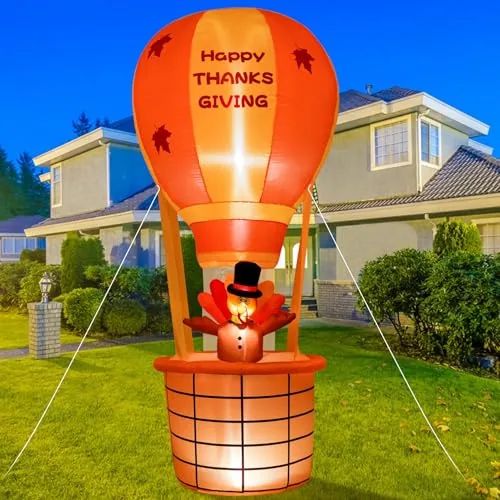
A lit figure is a simple machine. A fan holds it up, a cord feeds the fan, and stakes and rope keep the whole thing where you put it. Almost every problem people write to us about comes from one of those three.
Here is what the Onory workshop has learned through ten seasons on our own lawns, and where the people who write the safety rules agree or disagree with us.
Power comes first, and it decides where the figure goes
Work backwards from the outlet. The blower runs the entire time the figure is up, which on a December evening means five or six hours a night for six weeks. That is a long time for a cord to sit in wet grass.
The Consumer Product Safety Commission is direct about the outdoor part, and this is the one line in this guide worth reading twice:
When using lights outdoors, check labels to be sure they have been certified for outdoor use and only plug them into a ground-fault circuit interrupter (GFCI) protected receptacles or a portable GFCI.
U.S. Consumer Product Safety Commission, CPSC Warns: Avoid Hazards Related to Holiday Decorating
A portable GFCI costs about as much as a takeaway and plugs into an ordinary outdoor socket. If your outdoor outlets are old and have no test and reset buttons on them, buy one before you buy a second figure.
The same release gives the rule most people break, us included, in the first week of a good season:
Turn off all holiday lights when you go to bed or leave the house. The lights could short out and start a fire.
U.S. Consumer Product Safety Commission, CPSC Warns: Avoid Hazards Related to Holiday Decorating
An outdoor timer solves this better than good intentions do. Set it to go off at eleven and the question stops coming up.
Anchors: the counts differ, and the box tells you which
Every lit piece we make ships with the same three things holding it down: stakes into the ground, ropes to the stakes, and sandbag pockets built into the base that you fill yourself. The counts are not the same across the range, because the shapes catch wind differently.
| Piece | Height | Stakes and ropes |
|---|---|---|
| Turkey Hot-Air Balloon, 7 ft | 7 ft tall | 6 stakes, 4 ropes, built-in sandbags |
| Penguin and Ornament, 4 ft | 4 ft tall | 3 stakes, 2 ropes, built-in sandbags |
| Thanksgiving Turkey, 6 ft | 6 ft tall | 4 stakes, 4 ropes, built-in sandbags |
| Halloween Witch, 10 ft | 10 ft tall | 3 ropes and 3 suction cups |
The wide pieces get more rope than the tall ones. A tail that fans out six feet behaves like a sail; a balloon on a narrow basket does not.
Fill the sandbag pockets even on a still week. They are the part that keeps the base flat while the fan is off, which is when a figure gets dragged.
What none of this survives
A staked, roped and weighted figure holds through ordinary weather. It does not hold through a storm, and no yard inflatable does. When a wind advisory goes up, unplug it and let it lie down on the grass.
A deflated figure lying flat has almost no surface for wind to push. That is the whole trick, and it takes about a minute.
We would rather write this here than sell you a piece that promises weather it cannot take. The material is polyester and the anchors are steel pins in soil.
Height, and the mistake people make with photographs
Photographs flatten scale. A four foot piece and a ten foot piece look nearly identical in a square photograph on a phone, and they are completely different purchases.
The rule we use: measure the gap the figure has to fill, then choose a piece about two thirds of that height. A seven foot balloon in front of a nine foot garage door reads properly from the road. The same balloon beside a two storey wall disappears.
Depth beats height once you have one piece. A four foot figure near the house plus a line of knee height signs along the path gives a front garden a sequence to walk through, and that reads better in December than a single tall figure standing alone.
7 ft, lit, 6 stakes and 4 ropes · $69.99
See the piecePlacement, and the thing our own product does wrong
Keep the figure off the walk. This sounds obvious in daylight and stops being obvious once the piece is up and looks good where it is.
The CPSC puts it plainly in its Halloween guidance, and the instruction cuts against our own interest:
Remove obstacles from lawns, steps and porches when expecting trick-or-treaters.
U.S. Consumer Product Safety Commission, CPSC Reminds Parents to Keep Trick-or-Treaters Safe this Halloween
We sell obstacles. A ten foot witch, a guy rope at ankle height in the dark, a stake in the middle of a lawn people cut across. On the one night of the year when strangers walk up your path in poor light and wearing masks, the ropes belong out of the walking line and the path belongs clear.
Run the ropes back towards the house rather than across the grass, and put the stake heads where a porch light reaches them.
The cord is the part people get wrong
A blower draws steadily rather than in bursts, so the cord question is not about power. It is about the cord being outdoors for six weeks in the wet.
The CPSC line on this is short, and the word doing the work is rated:
If using an extension cord, make sure it is rated for the intended use.
U.S. Consumer Product Safety Commission, CPSC Warns: Avoid Hazards Related to Holiday Decorating
In practice that means an outdoor cord, marked for outdoor use on the jacket, run in one piece from the socket to the figure. Two indoor cords joined in the middle of a lawn is the arrangement that fails, and it fails at the join.
Keep the join off the ground if you cannot avoid one. A plastic box for a couple of dollars does it, and so does a bread bag and a cable tie on a night when the shops are shut.
The same release gives a number worth holding on to. It is not about inflatables specifically, and it is still the reason we write guides like this one:
During November and December of each year, about 10,000 people are treated in hospital emergency rooms as a result of falls, cuts, shocks and burns related to holiday decorating.
U.S. Consumer Product Safety Commission, CPSC Warns: Avoid Hazards Related to Holiday Decorating
Falls come first in that list, ahead of shocks and burns. Most of the decorating that hurts people happens on a ladder, which is an argument for ground level pieces and against climbing to hang anything in December.
Matching the piece to the yard you actually have
Three shapes cover most front gardens, and they are not interchangeable.
- Tall and narrow. Good where a fence, a hedge or parked cars block the bottom four feet. The bright part of the figure clears the obstruction and reads from a moving car.
- Low and wide. Good for a porch front, a driveway edge or a bay window. It fills a horizontal gap that a tall figure leaves empty on both sides.
- Knee height, repeated. Signs and small pieces along a path. They only work in a sequence, and they need a porch light or a spotlight, because nothing inside them lights up.
A yard with one of each reads better than a yard with three of the same, even when the three cost more. Depth is what a photograph of a good display shows and what a list of heights does not.
The one combination we would talk anyone out of is two large figures side by side on a narrow lawn. They crowd each other, both lose their outline after dark, and the display ends up looking smaller than either piece alone.
Taking it down is half the product
Setup gets all the attention. Teardown is what decides whether the piece comes out again next year.
- Unplug and let it collapse fully. A figure packed with air still in it creases along the folds.
- Wipe the base. Grass and grit trapped in a fold will grind at the fabric all year in the loft.
- Dry it before it goes in the box. This is the only step people skip and the only one that ruins a figure.
- Put the stakes and ropes in the same box, in a bag. Losing them costs more than losing the manual.
Ten seasons in, the pieces that came back looking new were the ones that went away dry. That is the whole of Onory care, and it takes ten minutes in January.
Sources we read
| Source | Published by | Read |
|---|---|---|
| CPSC Warns: Avoid Hazards Related to Holiday Decorating | U.S. Consumer Product Safety Commission | 3 September 2026 |
| CPSC Reminds Parents to Keep Trick-or-Treaters Safe this Halloween | U.S. Consumer Product Safety Commission | 3 September 2026 |